It was hours before dawn, and Bethel Alemayehu, MPH ’26, was at home in Ethiopia, on a call with a friend at WashU. Due to the nine-hour time difference, Bethel was accustomed to making time for conversations at all hours. Then, her email alert chimed. It was the message she had been waiting for: Alemayehu had not only been admitted to the Brown School, but she had received scholarship support. “I was so happy!” she remembers. “I took a screen shot of the message and sent it to all of my friends and family — in the morning, of course, because it was still the middle of the night in Ethiopia.”
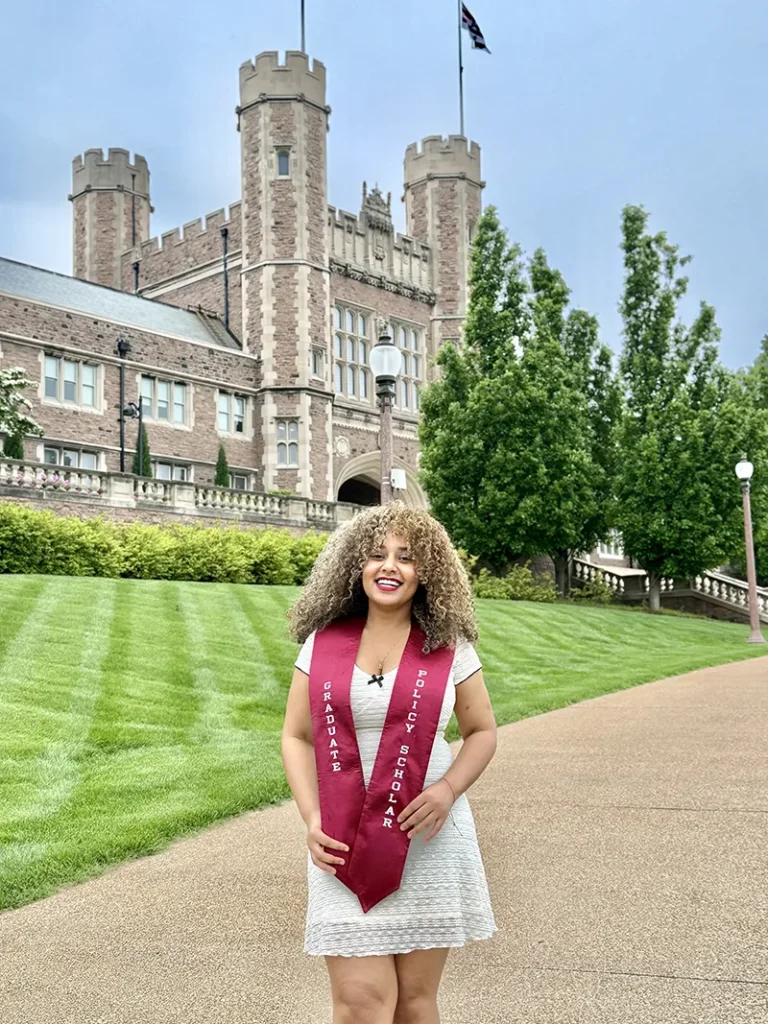
Fast forward two years. Alemayehu, who holds an MD from Addis Ababa University’s School of Medicine, graduated May 15 as a member of the inaugural class of WashU Burksy School of Public Health with a Master of Public Health in epidemiology and biostatistics. We sat down with her this spring to discuss her WashU experience.
Why WashU?
First, my parents were both teachers, so education is very important to my family. When I was looking at schools, I wanted to go somewhere that would complement my clinical background with rigorous quantitative training. I was looking for a research-intensive program that would help me explore what actually affects the health of a population at a school that was friendly to international students. WashU is that and more.
Tell us about your degree program.
My degree is a Master of Public Health. I started in the Brown School, but when the School of Public Health opened, the MPH transitioned to the new school. My focus is epidemiology and biostatistics. We understand patterns of disease on a population level and then use statistical methods to analyze the data and inform public health decisions. At many schools, this would be two separate degree programs, but at WashU, I’m lucky enough to be able to do both at the same time. I am hopeful I can leverage my research experience and the practical experience in my classes to continue working in clinical research here in St. Louis.
What does your scholarship mean to you?
The scholarship made it possible for me to choose WashU. As in international student, having that support is a big deal. I am here alone, without family, so being able to live and work in a new city without having to worry about tuition is a gift. Also, I see it as WashU’s belief in me. They saw my potential and wanted to make sure I was able to come study here.
In addition to your course load, you also worked for the WashU Engagement Center. Tell us a little bit about that experience.
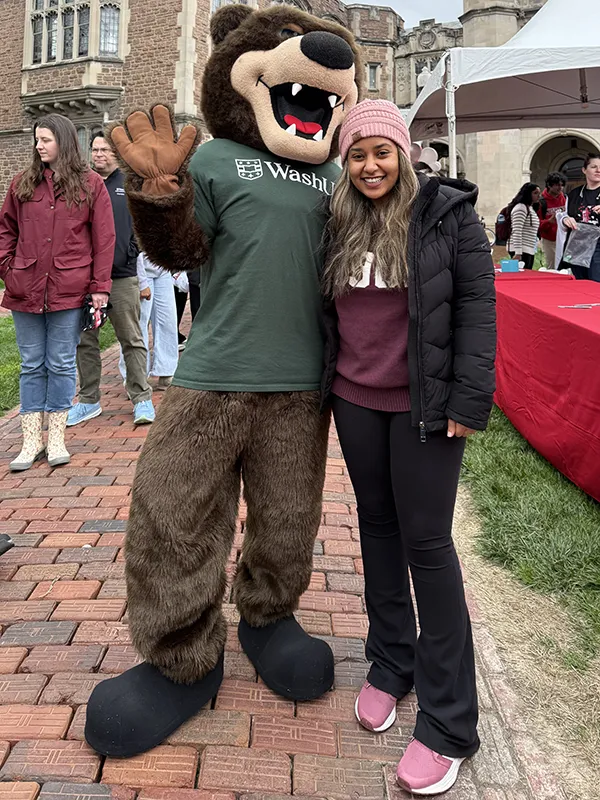
I called alumni to talk about their experiences and thank them for their gifts, and I also worked at special events. I really enjoy hearing alumni stories. One person told me this beautiful story about how he met his spouse at WashU. Another said I had to do his favorite thing on campus: take a walk behind Olin Library in the fall. So I did, and it was amazing, honestly. This job was not stressful; it’s something I really looked forward to.
What do you say to WashU alumni to encourage them to support the university?
First, I would want you to remember your experience at WashU. Even if you didn’t receive a scholarship, your time at WashU was made possible by donor support. Your gift enables students to have the same opportunities, or maybe even more opportunities, as you did. Second, when you give, it’s a way to stay connected. You can be part of the incredible new research and knowledge at WashU.
If you could change one thing in the world, what would it be?
I would give universal health care to everyone. I don’t think health should be a privilege; I want it to be something you get because you’re human. Everyone should have the right to be healthy or get healthy, and in an ideal world, it should be as free and accessible as possible.